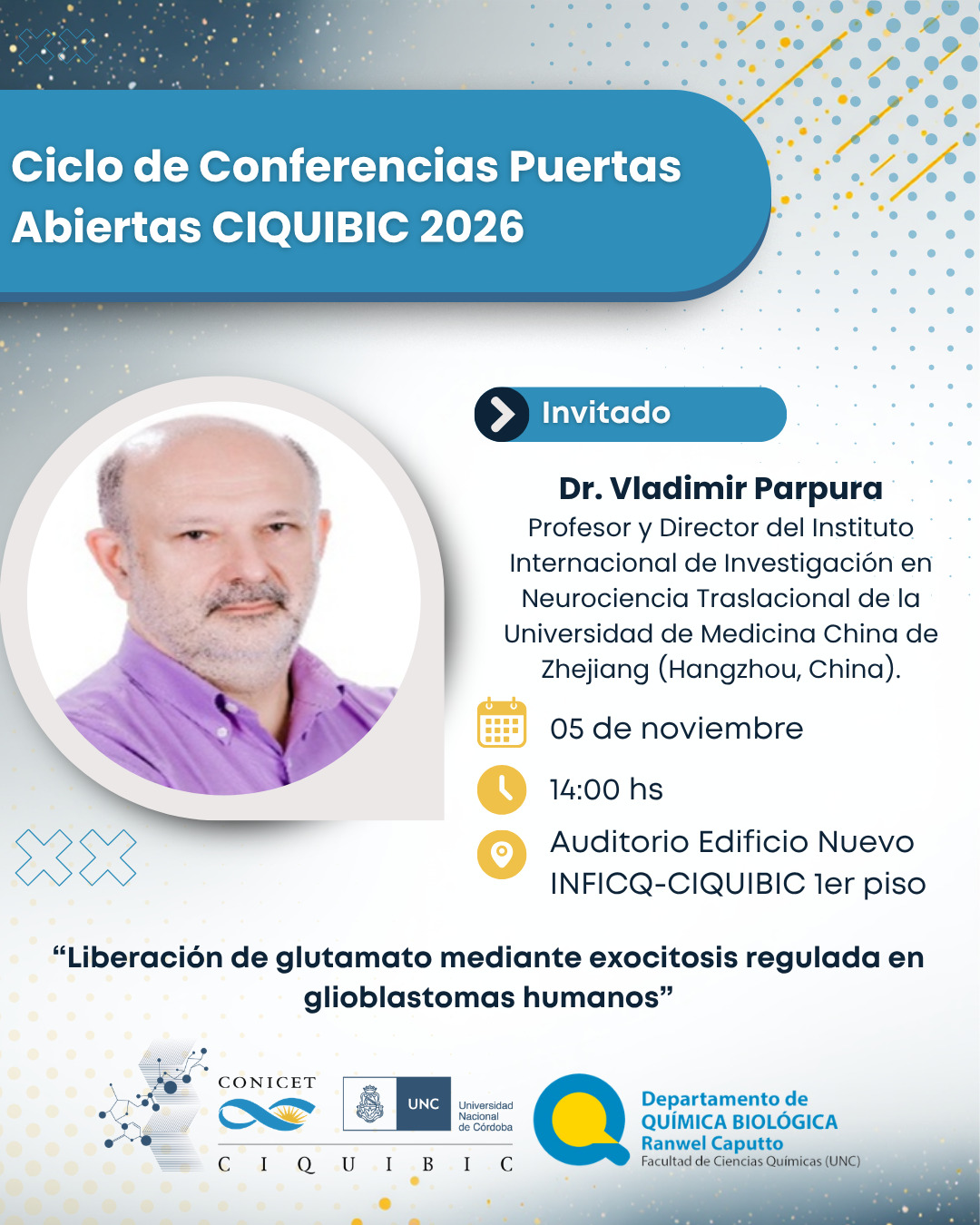
CICLO DE CONFERENCIAS CIQUIBIC 2026 – PUERTAS ABIERTASInvitado Prof. Dr. Vladimir Parpura“Glutamate release by regulated exocytosis in human glioblastomas”Estimados/as colegas, becarios/as y miembros de la comunidad académica: Nos complace invitarlos a una nueva edición del «Ciclo de Conferencias Puertas Abiertas del CIQUIBIC 2026″, en la que tendremos el honor de recibir al Prof. Dr. Vladimir Parpura. El Dr. Vladimir Parpura, MD, PhD, MAE, es Profesor Distinguido y Director del Instituto Internacional de Investigación en Neurociencia Traslacional de la Universidad de Medicina China de Zhejiang (Hangzhou, China). Obtuvo su título de Médico en la Universidad de Zagreb y su Doctorado (PhD) en Neurociencia y Zoología en la Universidad Estatal de Iowa. El Dr. Parpura descubrió la señalización mediada por glutamato desde los astrocitos hacia las neuronas, estableciendo el concepto de gliotransmisión y la «sinapsis tripartita». Su investigación interdisciplinaria integra la neurociencia con la nanotecnología, la biología sintética y la ingeniería biomédica. Ubicado entre los principales expertos mundiales en investigación de astrocitos y nanotecnología, se desempeñó como Presidente de la Sociedad Americana de Neuroquímica y actualmente se desempeña como Tesorero de la Sociedad Internacional de Neuroquímica (período 2025-2029). Es Miembro electo de la Academia Europaea, Fellow de la AAAS, Fellow de la Sociedad Fisiológica Americana y galardonado con el Premio al Exalumno Distinguido 2025 de la Clínica Mayo. Vladimir Parpura, MD, PhD, MAE, is a Distinguished Professor and Director of the International Translational Neuroscience Research Institute at Zhejiang Chinese Medical University (Hangzhou, China). He obtained his M.D. from the University of Zagreb and his Ph.D. in Neuroscience and Zoology from Iowa State University. Dr. Parpura discovered glutamate-mediated signaling from astrocytes to neurons, establishing the concept of gliotransmission and the "tripartite synapse." His interdisciplinary research integrates neuroscience with nanotechnology, synthetic biology, and biomedical engineering. Ranked among the top global experts in astrocyte research and nanotechnology, he served as President of the American Society for Neurochemistry and currently serves as Treasurer of the International Society for Neurochemistry (2025–2029). He is an elected Member of Academia Europaea, Fellow of the AAAS, Fellow of the American Physiological Society, and recipient of the 2025 Mayo Clinic Distinguished Alumnus Award. Título de la conferencia: “Glutamate release by regulated exocytosis in human glioblastomas” Vladimir Parpura and Vedrana Montana International Translational Neuroscience Research Institute, Zhejiang Chinese Medical University, Hangzhou, P.R. China Introduction: Glioblastomas (GBMs) are the most common primary malignant brain tumors in adults. They are one of the deadliest cancers, having a median survival of 14 months despite of standard of care (surgery, radiotherapy, and chemotherapy with temozolomide). GBMs are characterized by extensive dispersal throughout the brain, indicative of their highly invasive nature. Identifying novel treatments that stop/attenuate the progression of GBMs will be life altering. We propose a novel hypothesis that human GBM invasiveness is Methods: BK-evoked exocytosis were blocked in B2R high- expressing PDX GBM cells by icatibant and via transcriptional silencing of VAMP2. The effects were studied in both ex vivo and in vivo settings: A) Real-time visualization of human PDX GBM cell invasion into the normal brain parenchyma was examined in mouse acute slice preparations using laser scanning confocal microscopy. B) In mice bearing implanted PDXs, we will assess animal survival, tumor volume and GBM cells invasiveness. Results: Our data demonstrate that B2Rs are abundantly expressed on a subset of human GBMs. Our data further reveal that B2R activation in GBM cells causes exocytotic/vesicular glutamate release from human GBM patient-derived xenolines/xenografts (PDX), the best pre-clinical model of GBM. Blocking this pathway increasers survival time and decreases the GBM tumor progression in vivo. We posit that BK-evoked vesicular release of Glu could be a common mechanism of Glu release from GBMs and a therapeutic target to reduce invasiveness. 📅 Jueves 5 de Noviembre de 2026 🕒 14 hs 📍 Lugar Auditorio Edificio Nuevo CIQUIBIC (Modalidad presencial)Los esperamos para compartir este espacio de intercambio científico de primer nivel. Dirección CIQUIBIC – DQBRC
|